
Who’s Paying to Sell Us Amendment 3? Follow the Money.

Follow the Money: Florida — Installment 1 | Personal commentary by Chris Manzano | October 13, 2026
I’ve been seeing advertisements for Florida’s Amendment 3, and something has been bothering me. Not just the proposal itself. The money behind the message.
When we see expensive political advertising promising financial relief, how often do we stop to ask who paid for it? And why is that organization willing to spend millions convincing us?

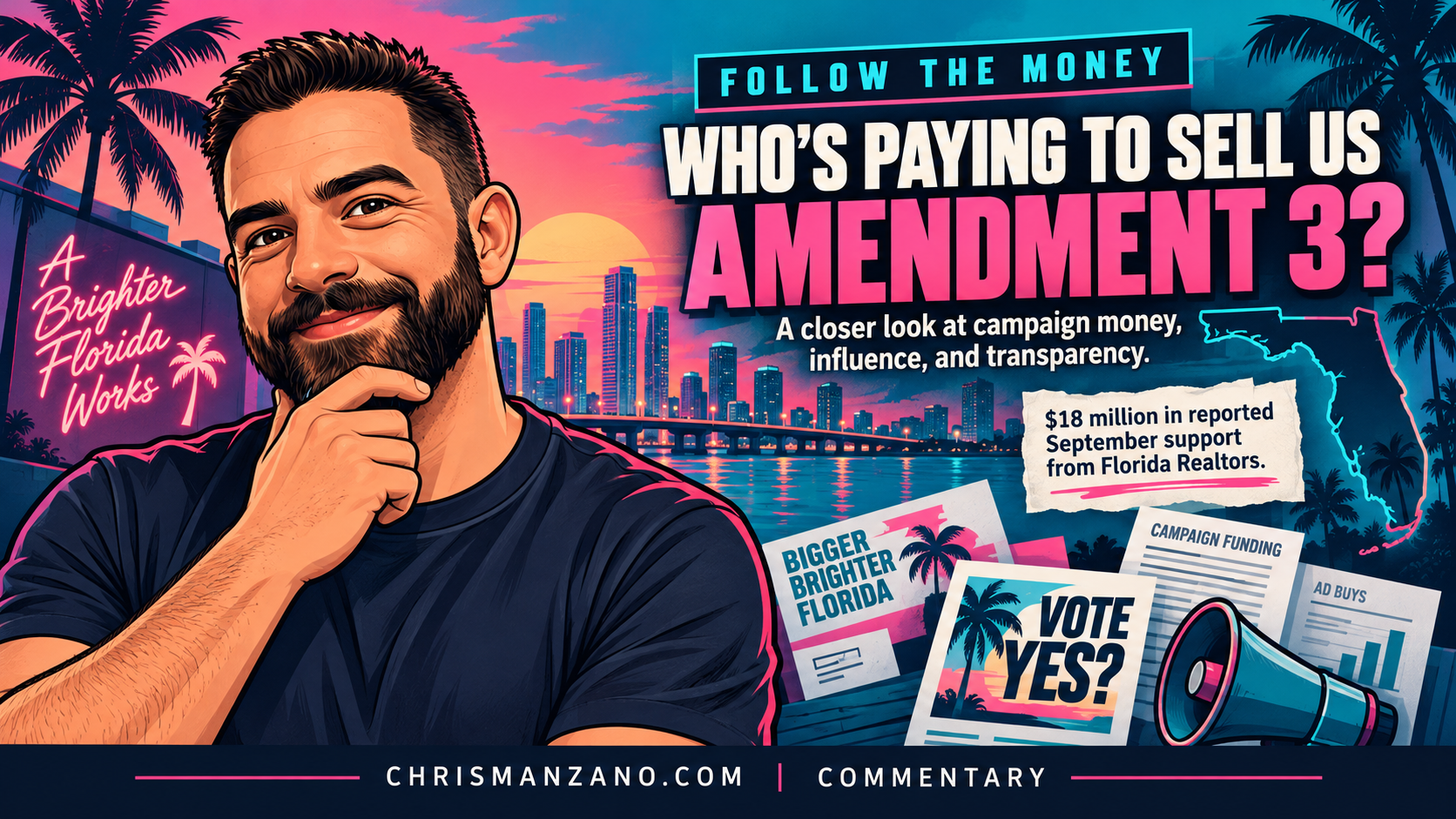
Editorial illustration, not a photograph of an actual advertisement or campaign record. The $18 million shown refers to reported September 2026 contributions; the depicted mailers and charts are illustrative, not source documents.
I work in real estate and mortgage lending. I understand how important affordability is. I also understand that businesses and industry organizations advocate for policies they believe will help their members.
But I have become increasingly concerned about how much influence large organizations can have over public policy, especially when their financial resources dwarf those of ordinary residents.
This campaign-finance follow-up builds on my earlier Amendment 3 commentary on property taxes and community services
Follow the $18 million
WFLX reported on October 5, 2026, that the political committee supporting Amendment 3 received $18 million in September, all from Florida Realtors. The same report said two opposition committees had raised approximately $680,000 combined. That is a fundraising comparison of more than 26 to 1—not a verified ratio of advertising expenditures.
Those are dated reported figures, not a claim that they are the latest cumulative totals today. Contributions to a committee are not the same as payments to television stations, digital platforms or mail vendors. Establishing exactly where the money went requires the committee’s expenditure records.
Still, the size and concentration of those reported contributions deserve public attention. Florida Realtors is a real estate trade association, not one corporation. Supporting policies it believes benefit homeowners is a legitimate activity for an industry association. But when one organization supplies that much funding, I believe voters should look closely at the message and the interests behind it.
What Amendment 3 would change
Amendment 3 is a proposed property-tax change on Florida’s November 3, 2026 ballot. If approved, it would increase the homestead exemption for qualifying non-school property taxes to $150,000 in 2027 and $250,000 in 2028, with inflation adjustments thereafter. Additional residency conditions would apply to people who are not Florida residents on December 31, 2026.
It would also reduce the annual assessment-increase cap for non-homestead properties, including applicable rental and commercial property, from 10% to 5%. The proposal changes rules governing county and municipal property-tax revenue, while allowing other expenditures approved by the appropriate local officials unless prohibited by general law.
These are changes to taxable value and local-government finance, not a guarantee of a particular household’s savings. Tax rates, fees and other charges also matter. And the proposal should not be described as directly repealing consumer-protection laws or deregulating insurance companies.
What Florida Realtors says
Florida Realtors publicly says it supports Amendment 3 to reduce the ongoing cost of homeownership and help families remain in their homes. Its campaign also argues that a lower non-homestead assessment cap would make property taxes more predictable. That is its stated rationale, and it deserves to be represented fairly.
I understand why homeowners want relief. I also want a clear explanation of how communities would maintain services when their tax base changes. Whether the result is greater efficiency, different taxes or fees, reduced services, or some combination should be examined—not assumed.
My bigger concern is corporate influence
Here is where my concern goes beyond this one amendment: I believe we should question the assumption that making government smaller automatically makes people’s lives better.
Sometimes government is inefficient. Sometimes public money is wasted. Sometimes regulations impose unnecessary costs. But I also want government capable of enforcing consumer protections, investigating wrongdoing and holding powerful interests accountable.
When public resources are reduced, who fills the gaps? Does it create greater efficiency? Does it shift expenses to residents through other taxes, fees or private services? Could certain businesses benefit more than ordinary households? Those are questions worth examining rather than assuming the answers.
I’m not claiming Florida Realtors financed Amendment 3 to weaken consumer protections. I have not seen evidence establishing that motive. Nor does this article establish that insurance companies secretly financed its contributions.
What I am saying is that I worry about a political environment in which well-funded organizations can shape the conversation far more easily than the communities affected by the resulting policies. That concern applies regardless of which side of an amendment an organization finances.
Lower taxes and strong consumer protection can both matter
I don’t believe wanting lower taxes and wanting strong public protections are mutually exclusive. We can question excessive spending while expecting public officials to explain where money goes. We can support affordable homeownership while asking how changes in local revenue affect the services residents depend on.
We can also recognize the legitimate role of businesses while demanding transparency about political contributions. For me, the issue isn’t simply whether government should be bigger or smaller. It’s whether government is accountable, whether people receive useful services for their money, and whether the rules protect the public fairly.
Transparency should not be optional
I would like to see clear, accessible answers to six basic questions:
Who contributed to each Amendment 3 campaign committee, how much, and during which reporting period?
How much was actually spent on advertising, and which firms received those payments?
What would different types of homeowners save, and how would those savings vary?
What revenue changes should counties, cities and special districts plan for?
How would local services be maintained if revenue decreases?
How can residents—not just well-funded interests—have a meaningful voice in the decision?
The point of following the money is not to decide that every donor is corrupt. It is to make the financial relationships and policy tradeoffs visible enough for people to reach informed conclusions.
The question I’m left with
I understand why homeowners want financial relief. I understand why the real estate industry would support policies it believes improve affordability. But residents should understand who is paying to promote major policy changes, what those changes actually do, and which consequences remain uncertain.
We deserve more than advertising slogans. We deserve reliable numbers, less corruption, meaningful consumer protections and greater transparency from both government and the organizations seeking to influence it.
Before we decide what government should cost, we should understand who is shaping the conversation—and what the public stands to gain or lose.
Sources and reporting limits
The sources above were reviewed for this October 13, 2026 installment. Contribution totals are attributed to the dated reporting, not to an independently downloaded complete campaign ledger. Later filings may change the totals. The database link is provided for readers to examine records; it is not proof that every transaction or advertising purchase has been audited.
Contact
Have a public record, a correction or a question worth examining? Contact Chris Manzano at Chris@ChrisManzano.com or 305-999-5664. Source documents are welcome; conclusions still need evidence.
Personal commentary: This article expresses Chris Manzano’s views, not a statement on behalf of Florida Realtors, an insurer or a campaign committee. It does not allege illegal campaign activity or establish improper motives by a contributor. Tax effects depend on the final applicable rules and individual circumstances. The artwork is an editorial illustration, not documentary evidence.


Comments